From the 2026 World Cup to the A-League: a striker archetype with SkillCorner data

Australia opened the World Cup with a 2-0 win over Turkey. New Zealand, drawn in one of the tough groups, took a 2-2 off Iran with two goals of their own. Two good openers from two teams almost nobody had in their bracket. And there is a detail that flies under the radar and that interests a scout a great deal: a good part of those squads is not cooked in the big European leagues, but at home and in the Australian A-League. Of New Zealand’s twenty-six, nearly half play in their own country or in Australia.
What is interesting is that there is an open window to look at precisely that league. SkillCorner has released data from the 2024-25 A-League season, and not just any data, but their specialty: off-ball runs and physical metrics, plus passing data. That is, the information traditional event data does not capture. And alongside that data they published a concrete example of how to build striker archetypes, which you can read in their open data series article. What we are going to do here is precisely replicate that example, but inside Smart Scouting System: we take the same data, build the same striker archetype and reproduce their player comparison, to show that everything they do can also be done from our platform.
Why connect your own data
Before getting into the how, one idea worth making clear. If your club already works with SkillCorner data, it only makes sense to be able to load it into your scouting tool and exploit it your way, not stay locked into the catalogue of metrics that a closed platform decides to offer you. The beauty of having physical and off-ball run data is precisely that layer event data does not give you: how many runs in behind a striker makes, how many to receive between the lines, his top speed, his volume of high-intensity efforts. If you pay for that information, you should be able to exploit it yourself, with your own profiles and your own criteria.
Smart Scouting System is built that way, without tying you to a single provider. You connect whichever source you want and work on it. Let’s see it with SkillCorner’s open data.
Loading and mapping the data
If your club already has SkillCorner data, you load it into Smart Scouting System and work with it. For this example we use the public A-League release, but the flow is identical with the data your club has access to.
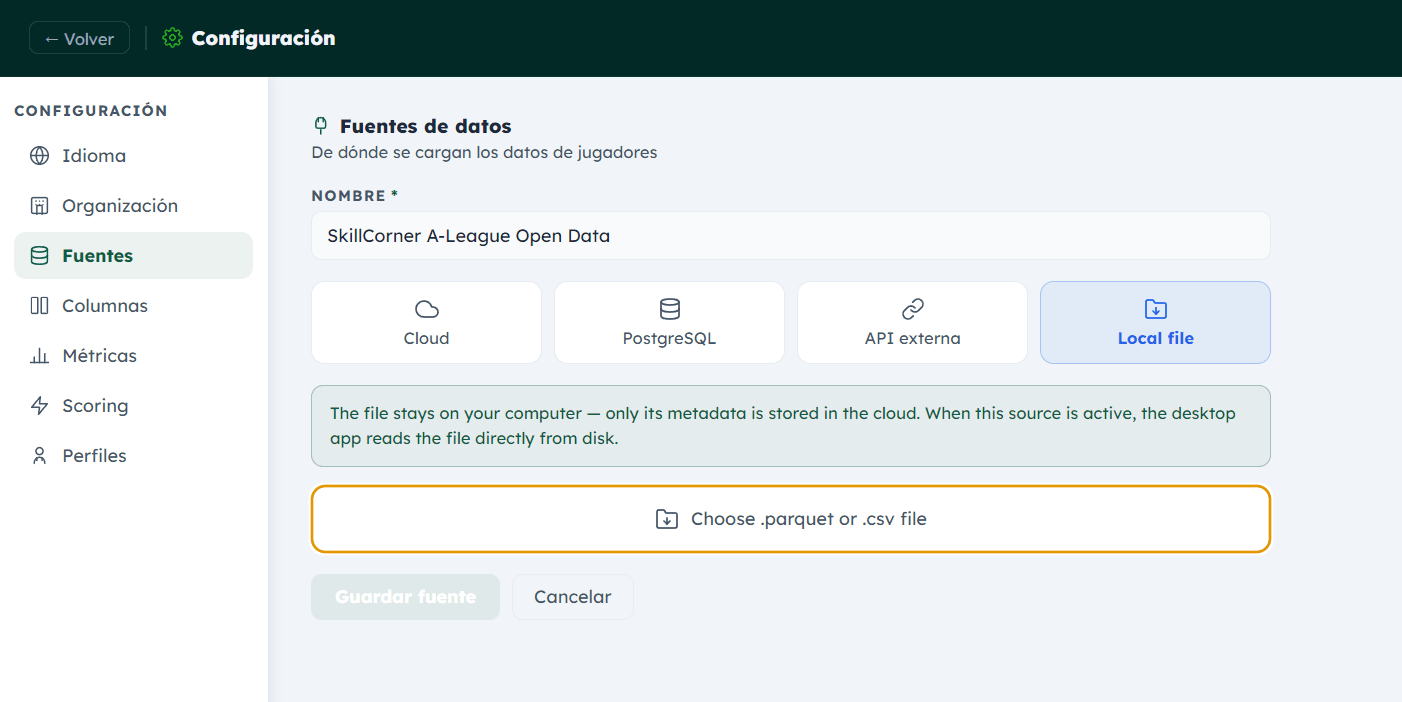
The file goes through a small amount of preprocessing before uploading, it is not loaded raw. SkillCorner delivers the information in several blocks, physical, off-ball runs and passing, so first you have to merge them into a single table and normalize the physical metrics per ninety minutes. With the file ready, you register the source. The file stays on your machine or cloud and only its metadata is stored, so the app reads it when the source is active.
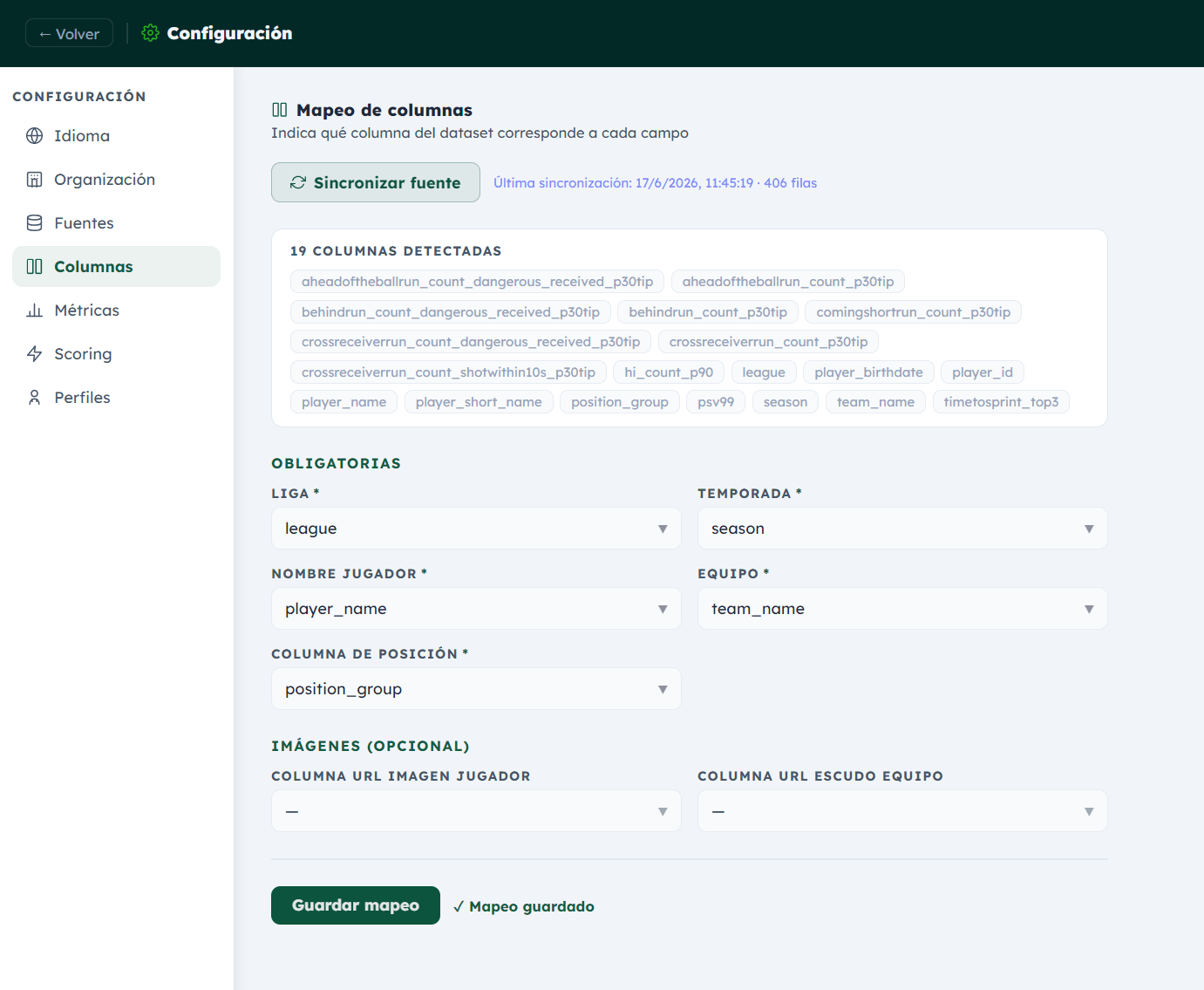
Once loaded, you have to tell the tool which column of the dataset corresponds to each field: league, season, player name, team and position. This is no minor formality, because these are exactly the fields the ranking is later calculated on. Each player’s z-score is computed within his season, his league and his position, that is, each striker is compared with the strikers of his own league and season, not with everyone.
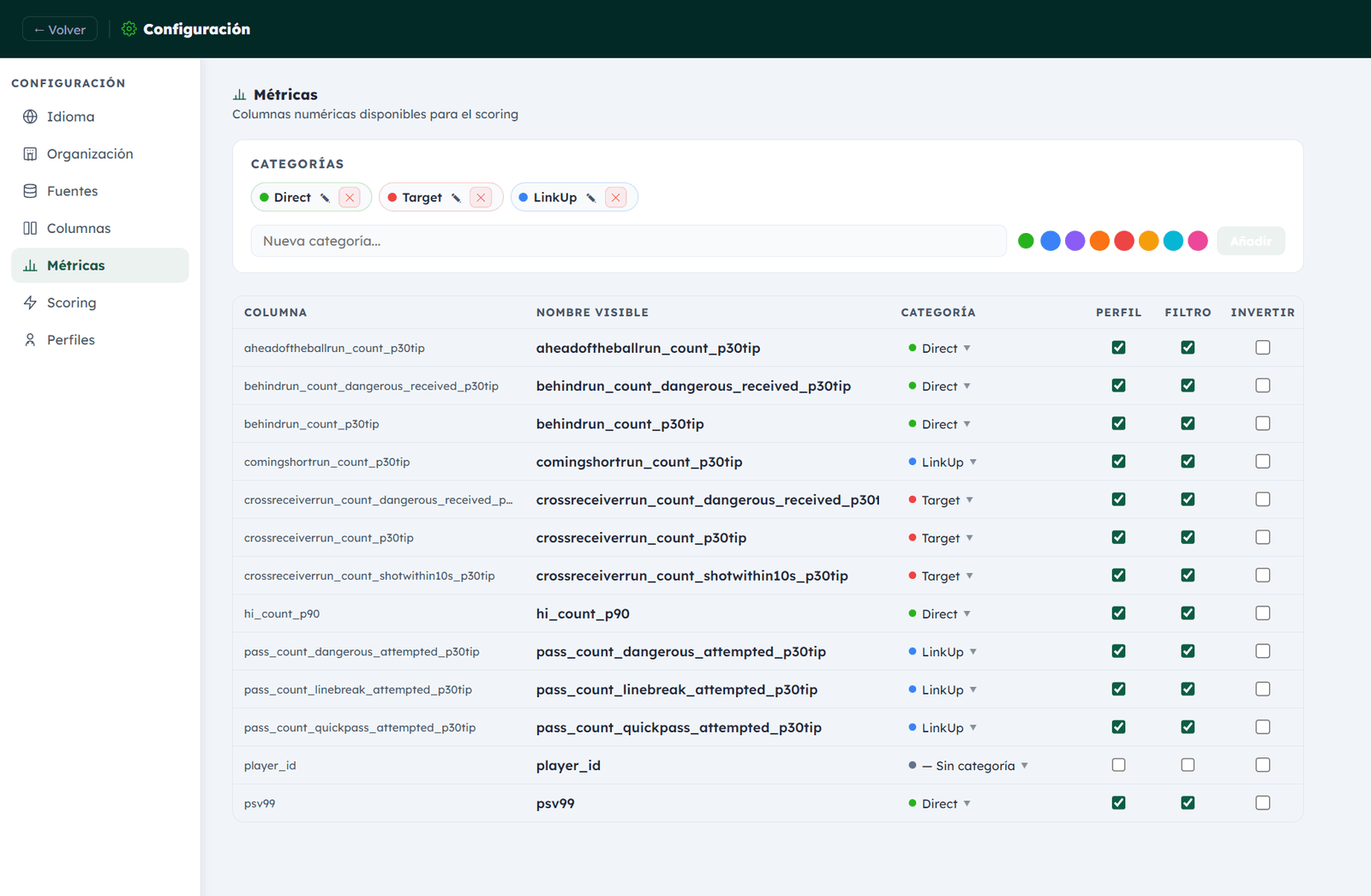
With the columns mapped, the next step is to choose which numerical metrics come into play and group them into categories. This is where judgment begins. Following SkillCorner’s archetype, we create three categories that describe three ways of being a striker: Direct, for the attacker who attacks space and runs in behind the defense; Target, for the finisher who lives off arrivals into the box; and LinkUp, for the associative striker who drops in to receive and combine.
Building the striker profile
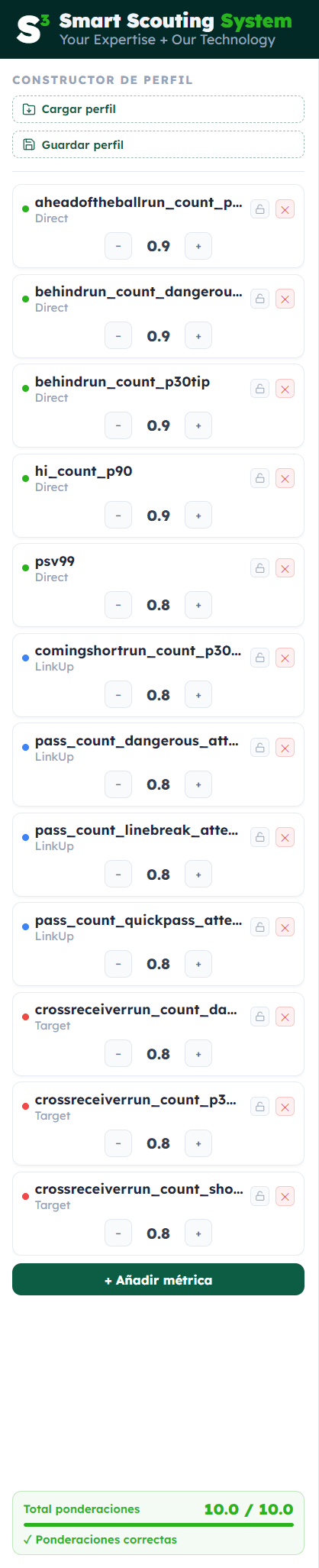
With the metrics classified, we build the profile. The logic is the same one SkillCorner applies in its striker radar: gather all the metrics and read which ones a player excels in to deduce what type of striker he is. Here we bring them together into a single profile and weight each metric according to our own judgment.
The difference lies in what the tool does with that reading: we turn it into a ranking. That same combination also translates into an overall striker score and a breakdown by category, which tells you at a glance how much each player has of Direct, of Target and of LinkUp.
It is worth understanding what this balance rewards, because it shapes how the ranking is read. With an even spread of weights, the profile favors the most complete striker, the one who performs decently across all three facets at once, over the specialist who dominates in just one. But that is not a limitation, it is a lever. If what we want is a specific type of striker, we just raise the weight of the metrics that define that archetype: loading the runs in behind and the top speed if we want a vertical number nine, or the passing and the runs to receive short if we want an associative one. The same profile, reweighted, becomes a search built to measure for each idea of play.
Searching among the players
We apply the profile to the A-League 2024-25 center forwards with at least eight matches played, which is the threshold SkillCorner recommends when bringing run data into the equation. The system returns a ranking of twenty-two strikers.
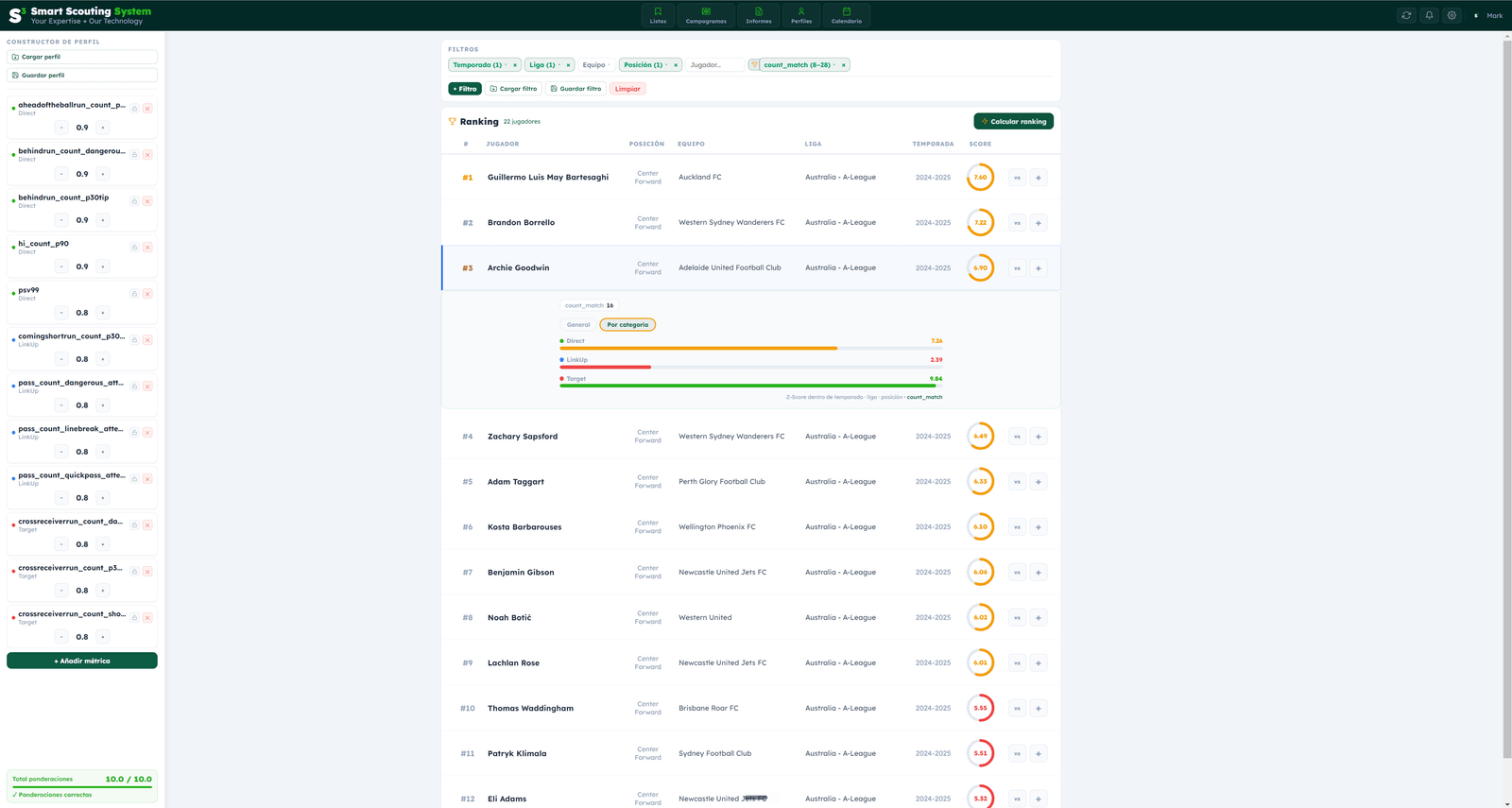
At the top are Guillermo May, of Auckland FC, as the most complete striker according to the blend, followed by Brandon Borrello and Archie Goodwin. But the overall ranking is only the entry point. The powerful part comes when you open each player.
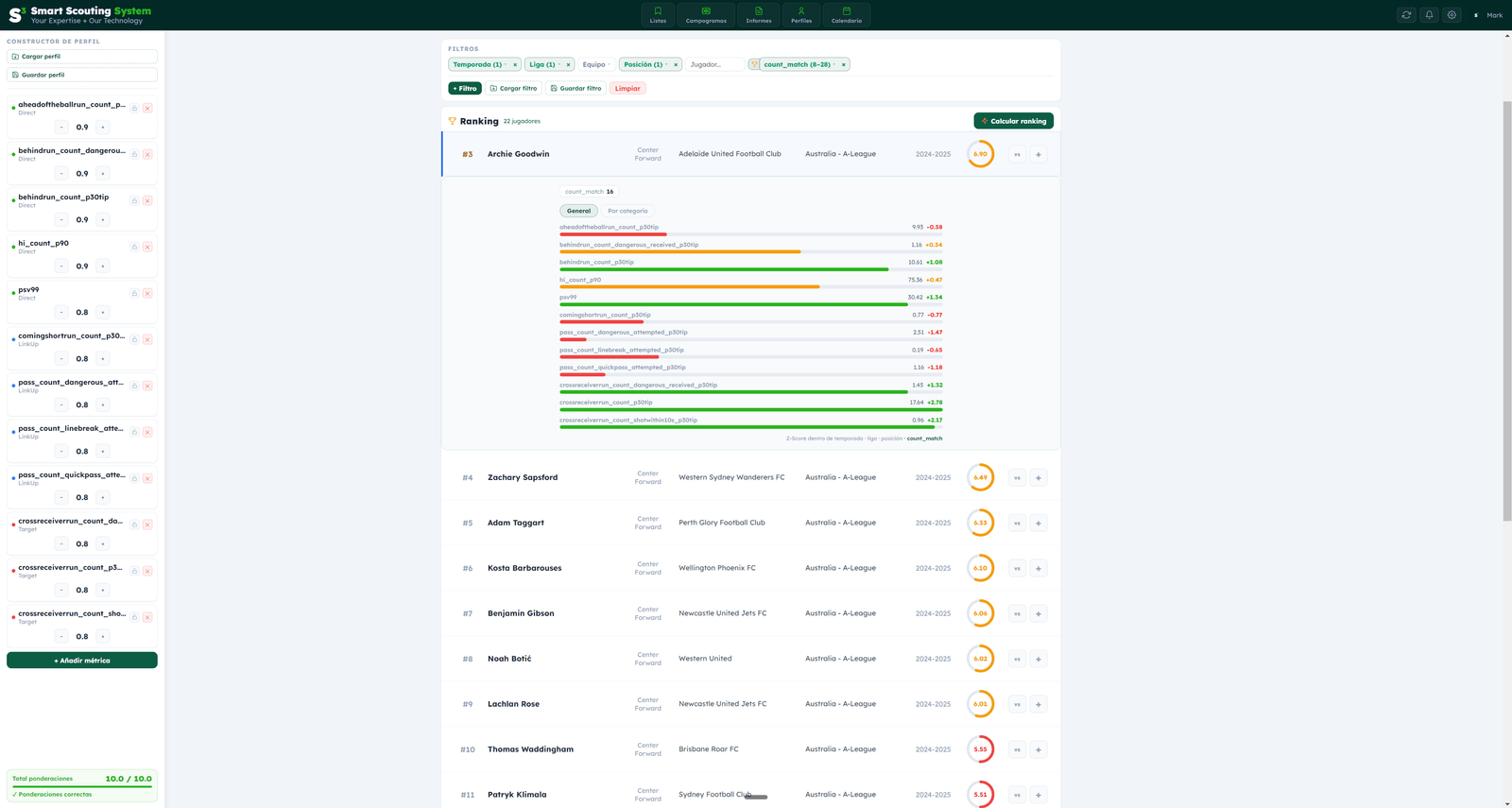
The by-metric view breaks down, one by one, where he excels and where he falls short relative to his peers. You see at a glance whether a striker piles up runs in behind and top speed, or whether instead he lives off passing and link play.
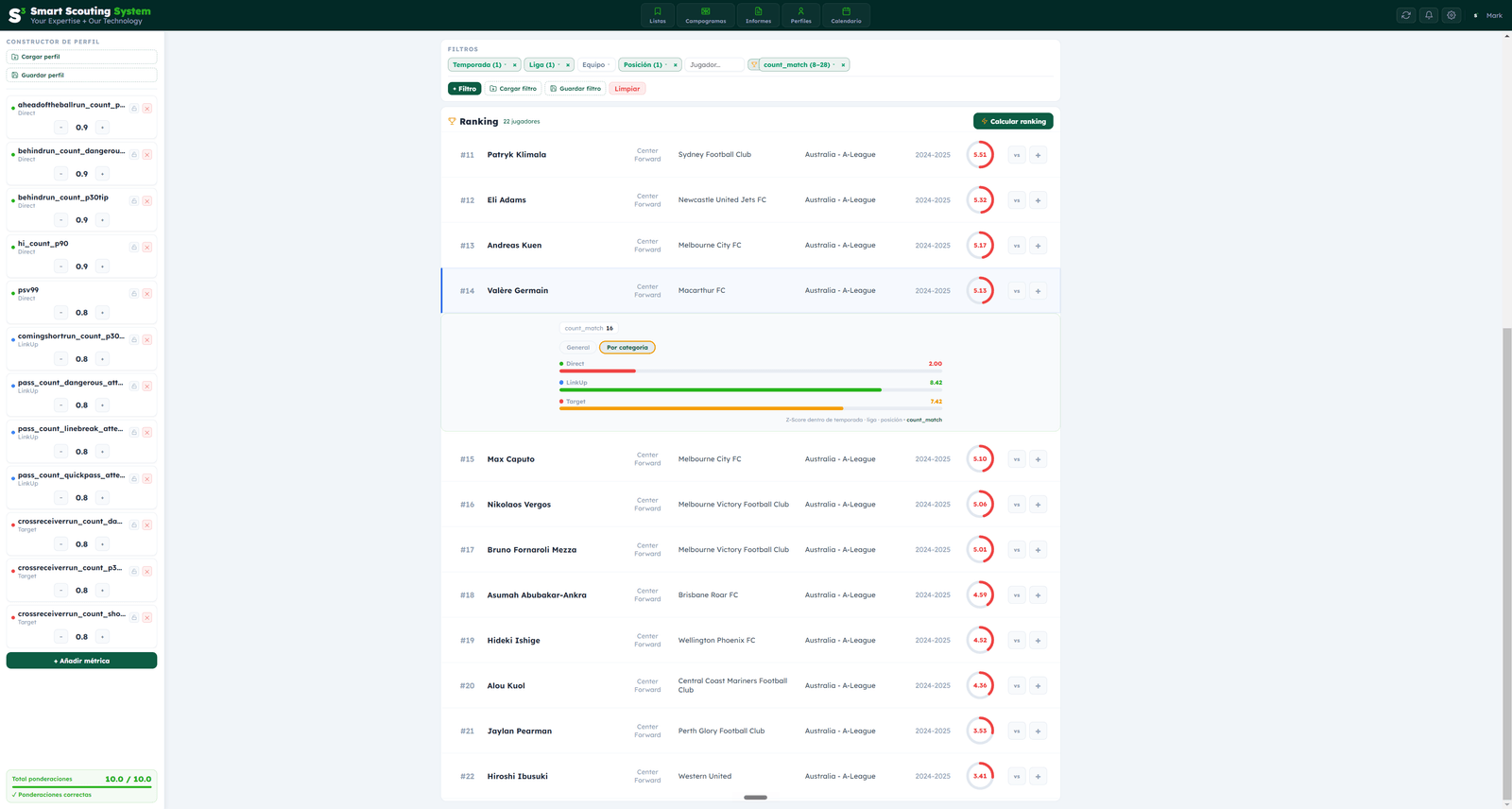
And the by-category view sums up that same information into the three archetypes. A striker can score very high in Target and LinkUp and low in Direct, which instantly portrays him as a box-and-combination nine rather than a runner.
The World Cup connection
In sixth place you find Kosta Barbarouses. A New Zealand international, with that 2024-25 season in the A-League, and called up for this 2026 World Cup with the All Whites. It is not an isolated case: the New Zealand national team leans heavily on players from its own country and from the A-League, exactly the nursery this open data lets you scout. Put another way, you are not going to find a Chris Wood, because he is already at the elite level and signed, but it does let you explore the breeding ground the next ones come from.
And there is a second sign that the profile is looking where it should. Archie Goodwin, third in our ranking and one of the strikers with the most runs into the box in the whole league, made the jump to MLS to sign for Charlotte FC.
Comparing two different profiles
To close, let’s compare two strikers the same ranking places in opposite worlds: Goodwin himself and Valère Germain.
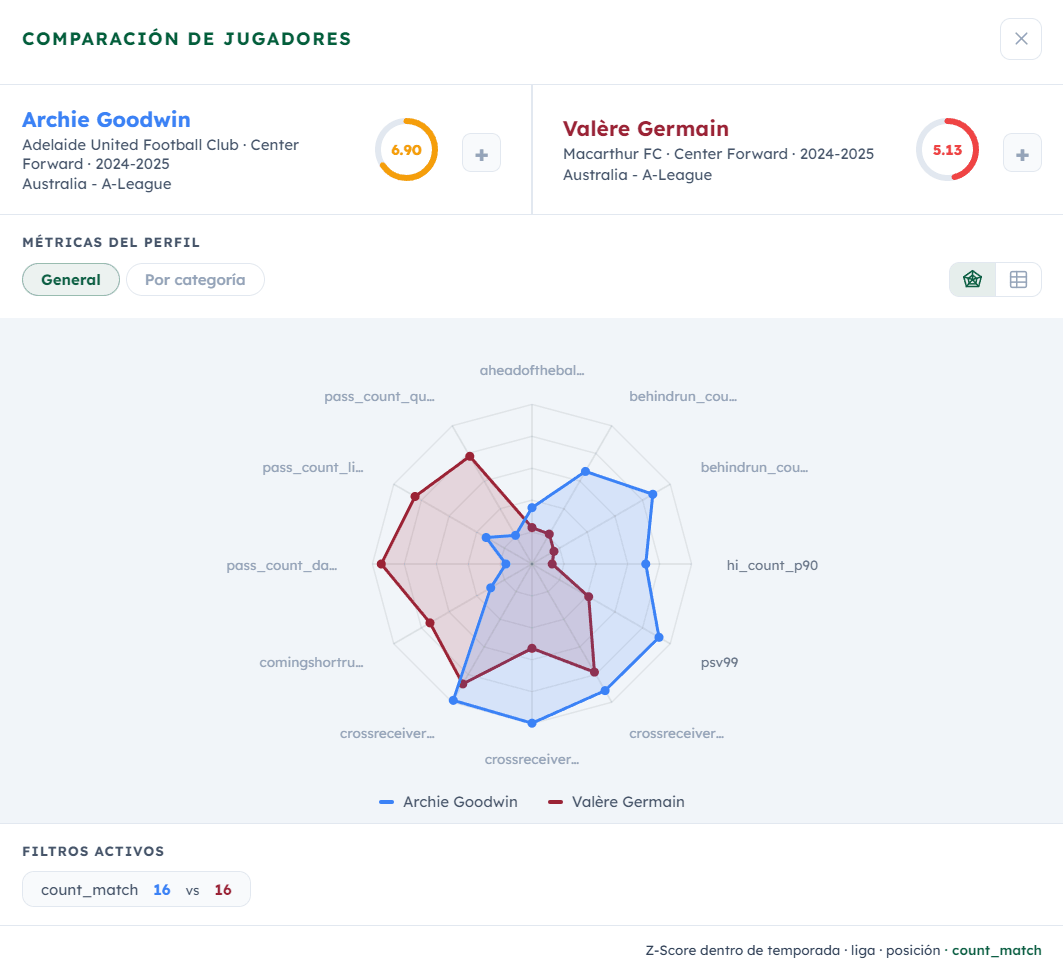
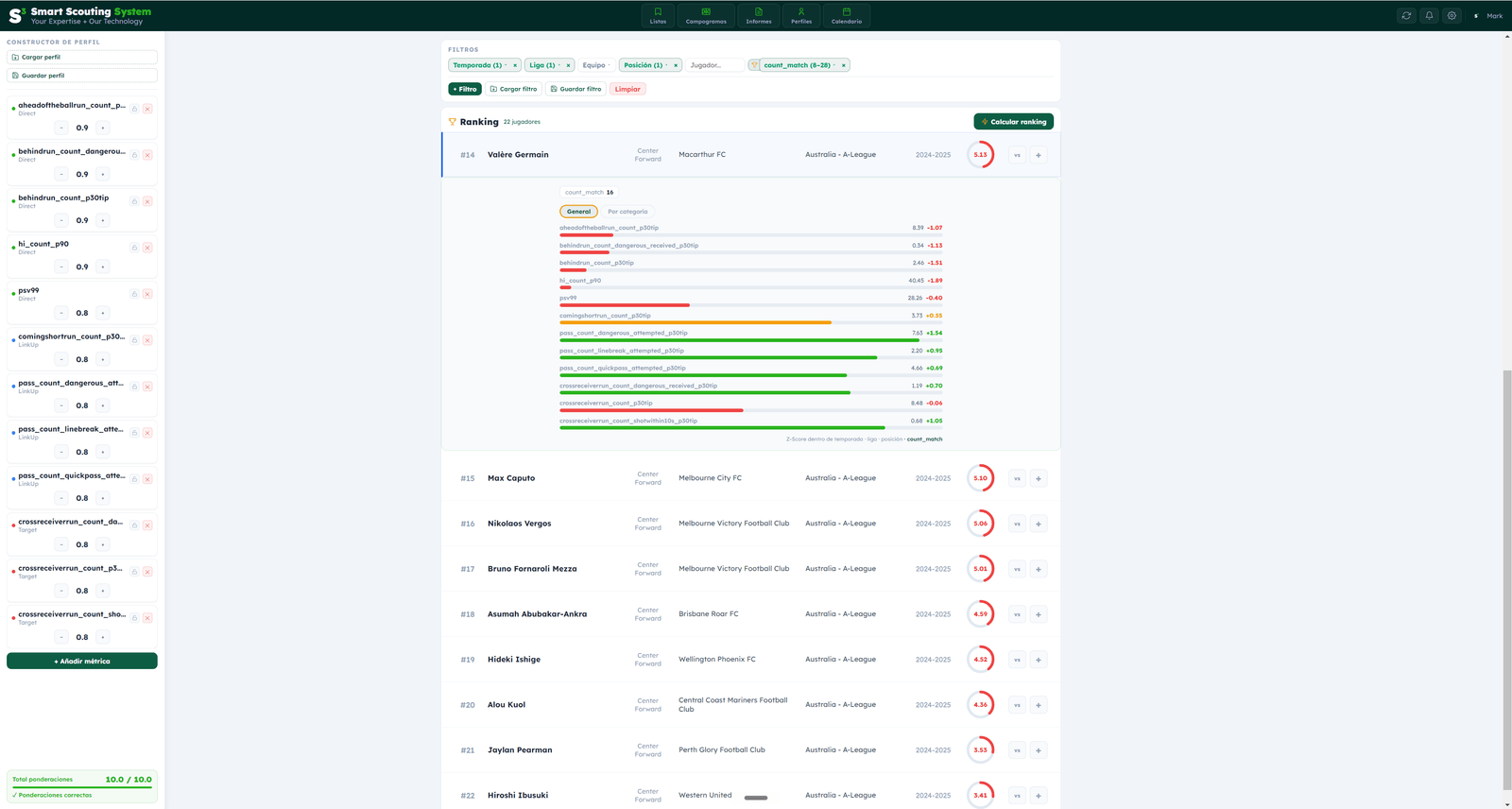
The radar says it all. Goodwin dominates the runs in behind, the arrivals as a cross receiver, the high-intensity efforts and the top speed. He is a vertical striker, of space and finishing. Germain occupies the opposite side of the chart: dangerous passing, passing between the lines, runs to receive short. He is a combination nine who drops to weave the play.
The by-category view confirms it without nuance. Goodwin is Direct and Target, weak in LinkUp. Germain is LinkUp and Target, almost nil in Direct.
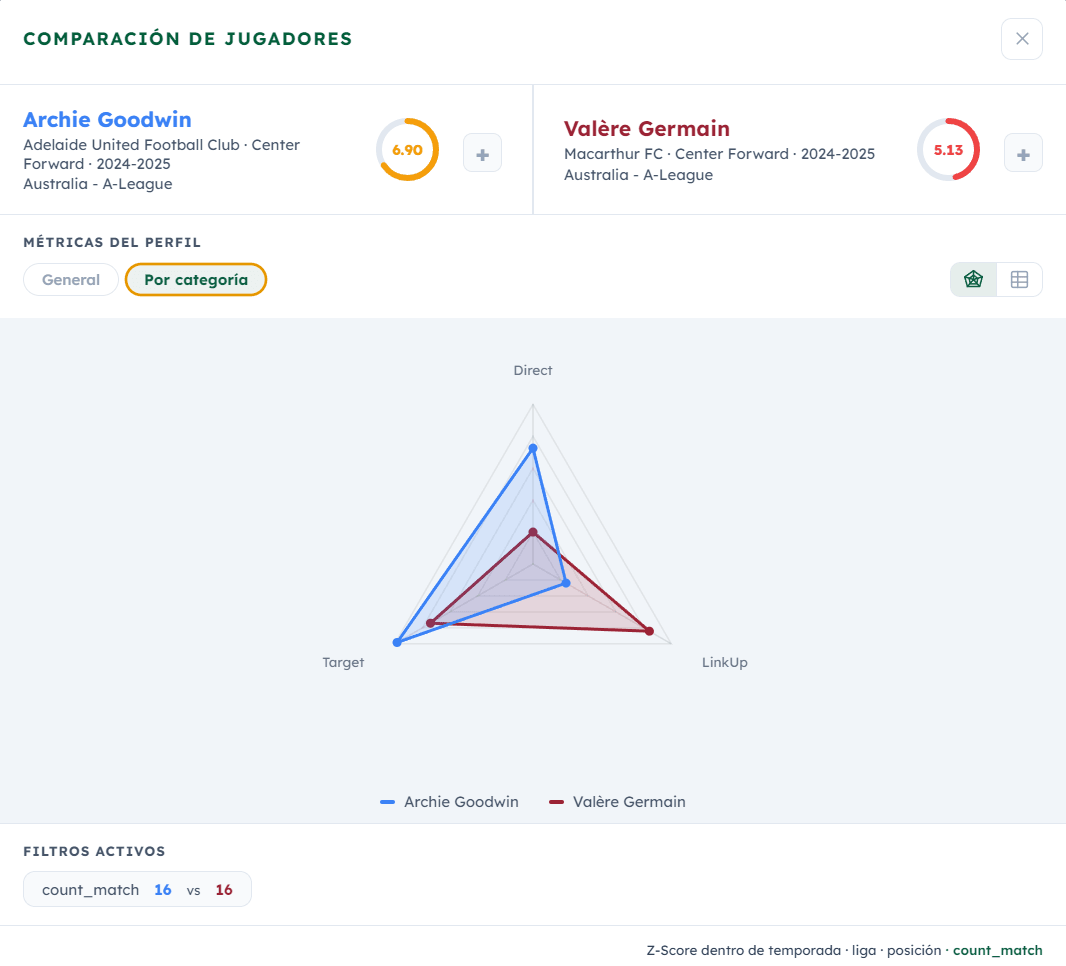
Neither is better than the other in the abstract. They are different tools for different needs. If your team attacks spaces in behind, you want Goodwin. If it builds short and needs a nine who links, you want Germain. The archetype does not decide for you, it orders the pitch so that you decide.
What it offers and what it doesn’t
As always, the data is the first filter, not the last word. What we have done here is turn three data files into a ranking of strikers with arguments, by archetype and comparable to one another, in a single working session. From there comes the usual: video, the pitch, context and a report.
If you have access to SkillCorner data, with its unique layer of off-ball runs and physical performance, it makes no sense to give it up by working on a platform that does not support it. Connect it to yours, build your own profiles and exploit the information you are already paying for.
The data used in this article comes from SkillCorner’s open data release of the 2024-25 A-League, and the striker archetype framework is inspired by their open data series.